Best Threat Intelligence Software: Top 9 Solutions in 2025
- 9 minutes to read
Table of Contents
What Is Threat Intelligence Software?
Threat intelligence software collects, analyzes, and implements actionable information about potential threats to an organization’s IT infrastructure. It collates data from various sources, such as cyber attacks, malware, and vulnerabilities, to detect patterns and predict future threats.
These insights help in making informed decisions to mitigate risks and improve security measures. The software enables organizations to react to threats and anticipate and prepare for them by leveraging historical and real-time data.
Threat intelligence software integrates with existing security measures and tools to bolster an organization’s defense mechanisms. It can automate many aspects of threat detection and response, allowing for swift action against potential cybersecurity incidents. Most importantly, it helps to contextualize threats in terms of relevance and severity specific to an organization.
This is part of a series of articles about cyber threat intelligence.
Types of On-Premise Cyber Threat Intelligence Software
On-premise cyber threat intelligence software comes in several forms, each designed to address different aspects of threat detection and response within an organization’s infrastructure. Here are the primary types.
Security Information and Event Management (SIEM) Systems with Threat Intelligence Integration
SIEM systems collect and analyze log data from various sources across the network. When enhanced with threat intelligence feeds, they can correlate network events with known threat indicators such as malicious IP addresses, file hashes, or domain names. This integration helps in detecting targeted attacks and insider threats by providing real-time alerts based on contextual threat data.
Threat Intelligence Platforms (TIPs)
TIPs are specialized tools designed to collect, aggregate, and manage threat intelligence from multiple external and internal sources. They help security teams prioritize threats, enrich alerts with contextual information, and share intelligence across security tools. On-premise TIPs provide organizations with full control over their data, making them suitable for industries with strict data sovereignty requirements.
Endpoint Detection and Response (EDR) Tools with Intelligence Modules
EDR solutions monitor endpoints for suspicious activity and provide detailed visibility into endpoint behaviors. Some on-premise EDR tools come with integrated threat intelligence modules that help in identifying advanced persistent threats (APTs) and malware variants by correlating endpoint activity with known threat indicators.
Network Traffic Analysis (NTA) Solutions
NTA tools monitor network traffic for anomalies and known attack patterns. When coupled with threat intelligence feeds, these tools can detect threats such as command-and-control communications, lateral movement, and data exfiltration attempts. On-premise deployment ensures that sensitive network data remains within the organization.
Threat Intelligence Databases and Repositories
These are standalone systems that store curated threat intelligence data, such as indicators of compromise (IOCs), tactics, techniques, and procedures (TTPs), and attacker profiles. Security teams use these databases to manually investigate incidents or enrich alerts from other security tools.
Related content: Read our guide to threat intelligence tools (coming soon)
SIEM and Log Management Platforms with Threat Intelligence Module
1. Exabeam

Exabeam is a security operations platform that combines SIEM, UEBA, SOAR, and threat detection, investigation, and response (TDIR) capabilities to operationalize threat intelligence within on-premise and hybrid environments. The platform ingests logs and telemetry from across an organization’s infrastructure, correlates this data with external threat intelligence, and uses behavioral analytics to identify anomalous activity that may indicate insider threats, credential compromise, or lateral movement.
General features:
- Centralized log management and analytics for on-premise and cloud environments
- Automated threat timelines that consolidate events into clear attack narratives
- Integration with existing security tools, including firewalls, EDR, and SOAR solutions
- Flexible deployment options for on-prem, cloud, or hybrid environments
Threat intelligence features:
- Behavioral analytics and anomaly detection to surface threats that bypass signature- or rule-based detection
- Correlation with internal and external intelligence feeds for enriched context on IOCs and attacker TTPs
- Automated investigation and triage to reduce manual effort and shorten response times
- Open integration model to share threat intelligence across the SOC ecosystem without creating silos
Exabeam is often selected by organizations seeking to unify threat intelligence with detection and response workflows, enabling faster investigations and reducing alert fatigue in on-premise and hybrid SOCs..
2. Graylog

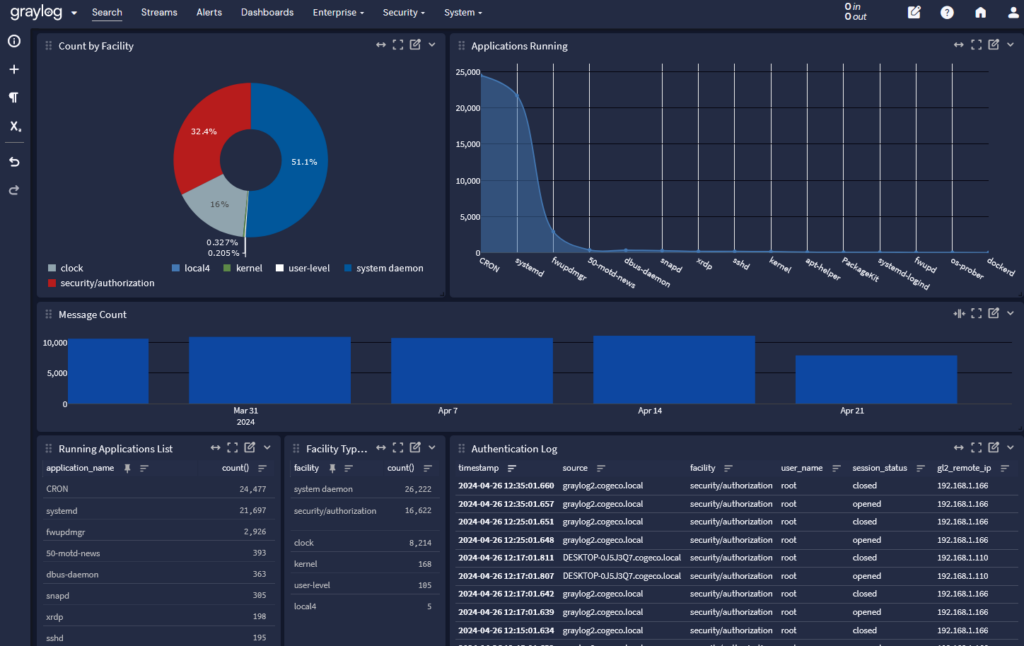
Graylog Open is a self-managed, open-source log management platform to aggregate, search, and analyze large volumes of log data from across IT environments. Built under the SSPL license, it provides flexibility and control for organizations looking to centralize log management without vendor lock-in.
General features:
- Log ingestion: Collects logs without worrying about volume constraints, ensuring visibility into system and application activity.
- Log viewing: Visualizes logs in using an interface to support active monitoring and communication across teams.
- Custom dashboards and reports: Allows users to build custom dashboards for real-time monitoring and generate detailed reports for analysis and compliance purposes.
- Extensible data collection: Supports collection from various data sources and allows for customization through plugins and community integrations.
Threat intelligence features:
- Search and analysis: Builds queries and performs searches quickly to detect issues, track incidents, and respond to threats.
- Custom alerts and notifications: Defines alert rules to monitor critical events and automatically notify the right stakeholders.
- Incident investigation and response: Accelerates root cause analysis and helps simplify response efforts using centralized, searchable log data.
- Correlation with external threat feeds: Integrates external threat intelligence feeds to enrich log data and improve detection of known threat indicators like malicious IPs and file hashes.
- Anomaly detection: Uses data analysis capabilities to detect unusual patterns that could indicate emerging threats.

Source: Graylog
3. ManageEngine Log360’s Threat Intelligence Platform

ManageEngine Log360’s Threat Intelligence Platform is an integrated solution to improve security operations by combining threat detection with contextual insights. It aggregates threat feeds from open-source and commercial sources, covering blacklisted IPs to provide visibility into malicious activity across the network.
General features:
- Real-time threat detection: Identifies and prevents communication with blacklisted IPs, domains, and URLs.
- Automated threat response: Supports automated workflows to block malicious IPs via firewalls and prevent further communication.
- Log management: Collects, stores, and analyzes logs from across network devices, servers, and applications.
- Compliance reporting: Includes prebuilt reports to help meet standards like GDPR, HIPAA, and PCI DSS.
Threat intelligence features:
- Integrated threat feed aggregation: Combines open-source and commercial intelligence, including feeds from partners like Webroot BrightCloud®.
- Contextual threat insights: Provides details such as IP geolocation, attack technique, and reputation scores to enrich alerts and investigations.
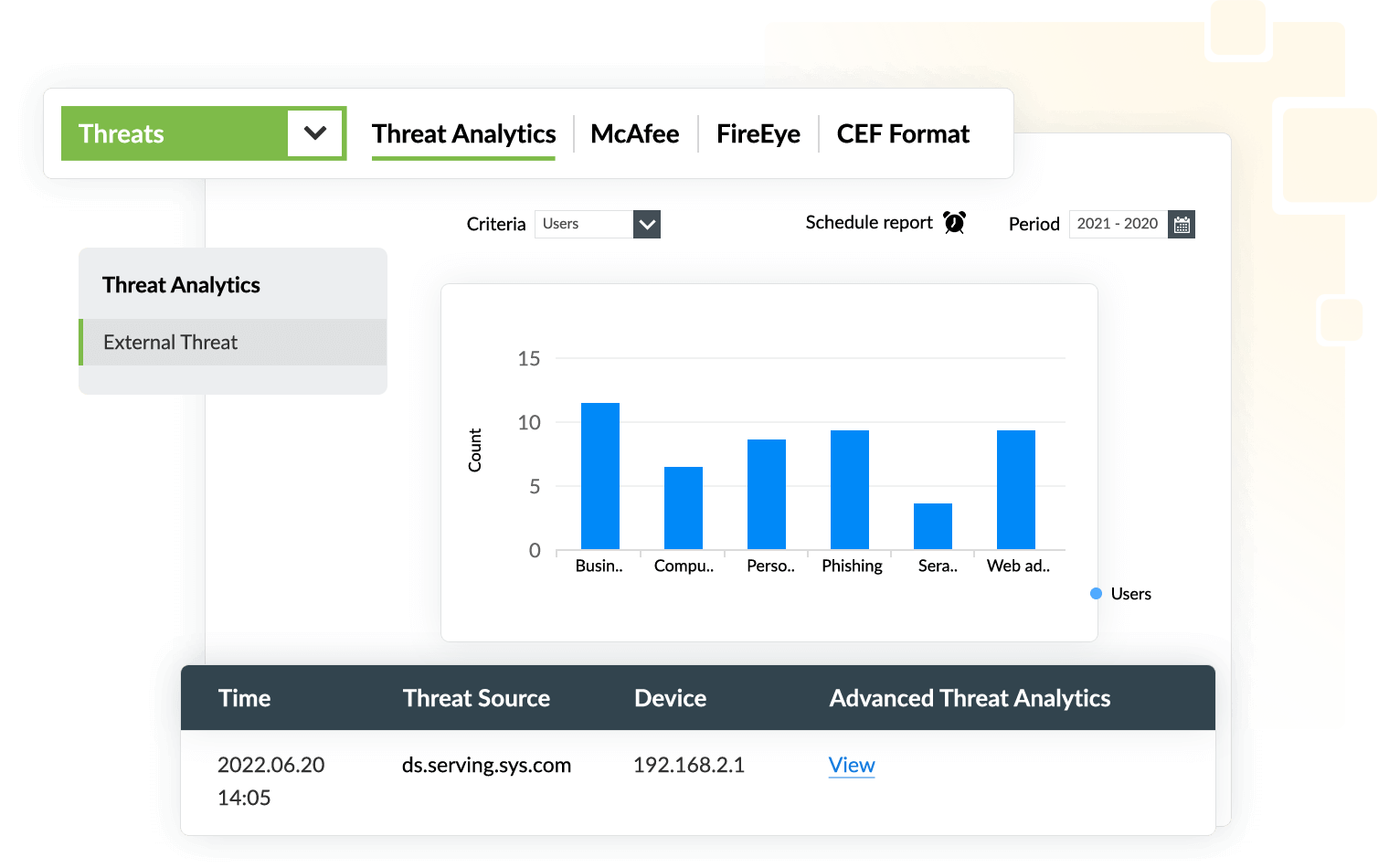
- Threat analytics add-on: Detects malware, phishing, and other attack types, and triages alerts based on severity and risk.
- Real-time IOC matching: Continuously monitors incoming log data and network activity for matches against known IOCs, allowing teams to respond quickly to emerging threats.

Source: ManageEngine
Commercial Threat Intelligence Platforms
4. ThreatConnect

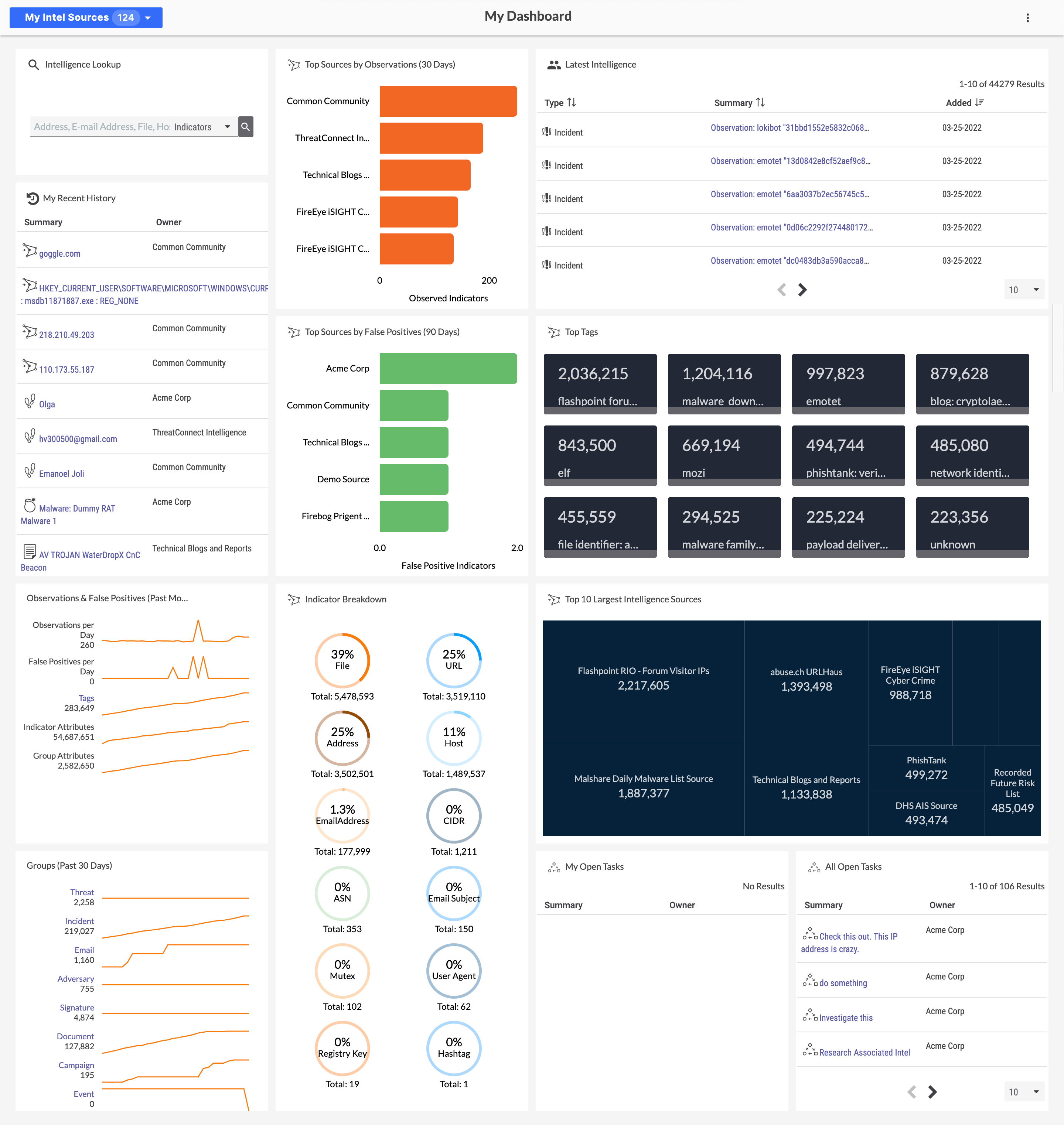
ThreatConnect is a threat intelligence operations (TI Ops) platform that helps security teams move beyond traditional threat intelligence platforms by unifying threat data, automating analysis, and operationalizing intelligence across the organization. It centralizes the ingestion, enrichment, and prioritization of threat intelligence from diverse sources.
Key features include:
- Unified threat intelligence management: Aggregates and normalizes threat data from multiple sources, creating a centralized threat library.
- AI-powered analytics: Uses CAL™ and other AI tools to provide real-time context, behavioral analysis, and global threat insights.
- Automated analyst workflows: Offers enrichment and customizable low-code Playbooks to automate manual processes and simplify operations.
- Visual threat analysis: Includes tools like ATT&CK Visualizer and Threat Graph to map out threat actor behaviors and discover relationships across data.
- Support for intelligence requirements: Enables CTI teams to align intelligence production with organizational priorities through documented and actionable intelligence requirements.

Source: ThreatConnect
5. Anomali ThreatStream

Anomali ThreatStream is a threat intelligence platform that transforms raw data into actionable insights by operationalizing one of the world’s largest repositories of curated threat intelligence. Designed for real-time detection, investigation, and response, it automatically correlates threat data with internal telemetry to deliver personalized, prioritized intelligence.
Key features include:
- Global threat intelligence repository: Access of curated OSINT, premium, and community feeds covering IOCs, IOAs, and TTPs.
- Automated intelligence distribution: Real-time delivery of machine-readable threat data to SIEMs, SOARs, EDRs, and firewalls for proactive defense.
- Contextualized threat insights: Automatically correlates intelligence with the vulnerabilities, delivering targeted, high-confidence alerts and dashboards.
- AI-powered investigation support: Leverages Anomali Copilot to accelerate research using natural language queries and automated report generation.
- Integrated threat modeling: Maps indicators to campaigns, malware, and ATT&CK TTPs for broader context.

Source: Anomali
6. Recorded Future

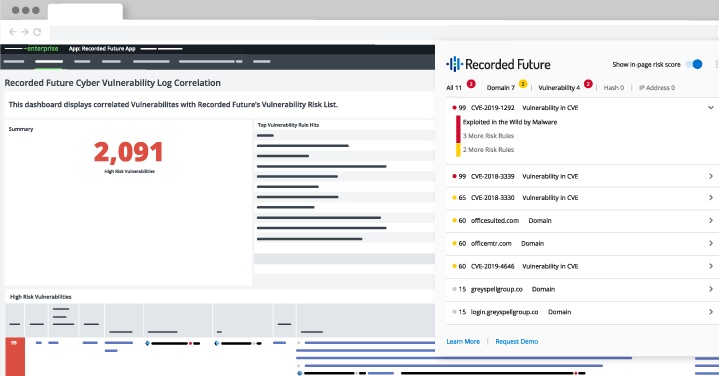
Recorded Future is a threat intelligence platform that provides organizations with tailored, real-time insights into cyber threats. It collects and analyzes threat data from a wide range of sources and applies AI-driven analytics to help prioritize and respond to the most relevant risks. The platform enables security teams to proactively identify threats, investigate indicators, and take targeted mitigation steps.
Key features include:
- Threat map: Visually displays threat actors and malware relevant to the organization, tracking trends over time.
- Sandboxing and behavioral analysis: Allows submission of files for malware detonation in a controlled environment with detailed behavior reports.
- Threat hunting packages: Offers prebuilt rule sets (YARA, Snort, Sigma) to assist in detecting specific adversaries or malware.
- Ransomware risk profiling: Provides visibility into ransomware exposure and actionable mitigation guidance.
- Victimology tracking: Displays real-time data on ransomware victims, categorized by industry, region, or supply chain relevance.
- Secure extortion site browsing: Enables analysts to safely view ransomware extortion sites without increasing organizational risk.

Source: Recorded Future
Open Source Threat Intelligence Platforms
7. MISP

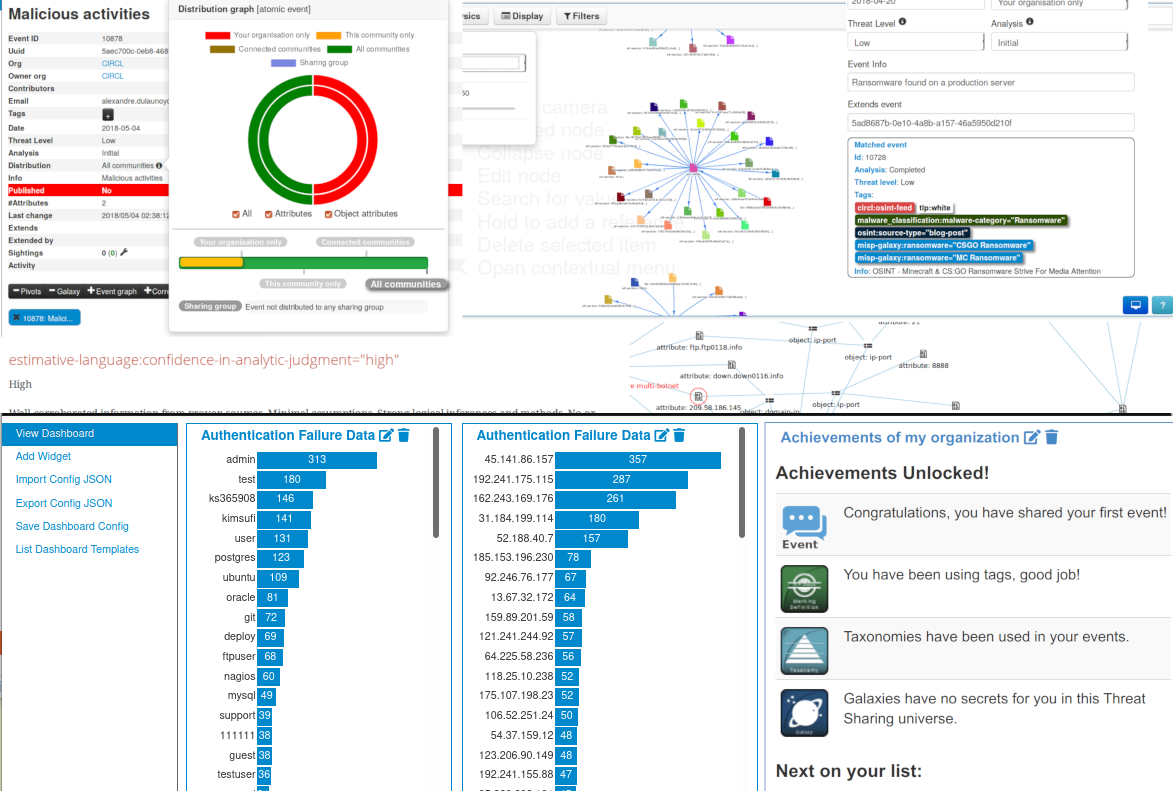
MISP (Malware Information Sharing Platform & Threat Sharing) is an open-source threat intelligence platform for collecting, storing, and sharing structured threat data. It enables organizations to turn large volumes of threat information into intelligence through automation, collaboration, and simplified workflows.
License: AGPL-3.0
Repo: https://github.com/MISP/MISP
GitHub stars: 5K+
Contributors: 200+
Key features include:
- Automated threat data handling: Automates correlation and export of threat data in formats like STIX and OpenIOC for integration with security tools.
- Simplified interface: Focuses on usability to make threat analysis and data sharing accessible.
- Collaborative sharing: Supports sharing with trusted partners and communities.
- Sata modeling: Allows threat objects and relationships to be represented and linked across incidents.
- Correlation engine: Detects relationships between indicators using matching, fuzzy hashing (ssdeep), and CIDR block matching.

Source: MISP
8. OpenCTI

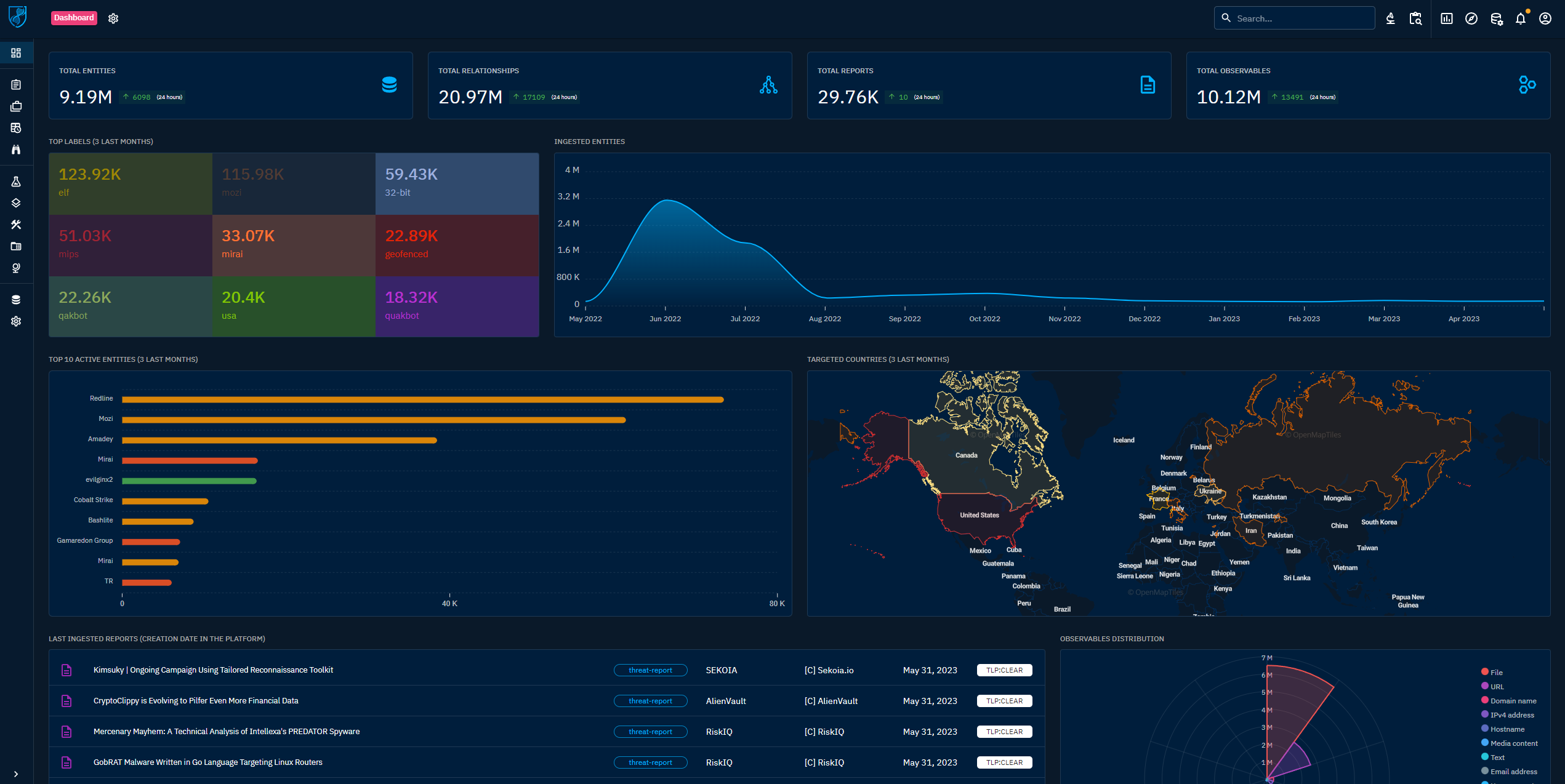
OpenCTI (Open Cyber Threat Intelligence) is an open-source platform to help organizations manage, structure, and visualize cyber threat intelligence. It supports both technical and non-technical threat data—such as observables, TTPs, attribution, and victimology—through a knowledge schema based on the STIX2 standard.
License: Apache-2.0
Repo: https://github.com/OpenCTI-Platform/opencti
GitHub stars: 7K+
Contributors: 100+
Key features include:
- Structured intelligence repository: Uses STIX2 schema to organize threat data, enabling clear connections between entities like indicators, incidents, threat actors, and reports.
- Integration with external tools: Connectors available for MISP, MITRE ATT&CK, TheHive, and others to enrich and synchronize intelligence.
- Custom knowledge modeling: Supports standard and user-defined data sets.
- Temporal and confidence data tracking: Records first/last seen dates, confidence levels, and source attribution for each piece of intelligence.
- Automated relationship inference: Automatically derives new relationships from existing ones to simplify complex threat data analysis.

Source: OpenCTI
9. YETI

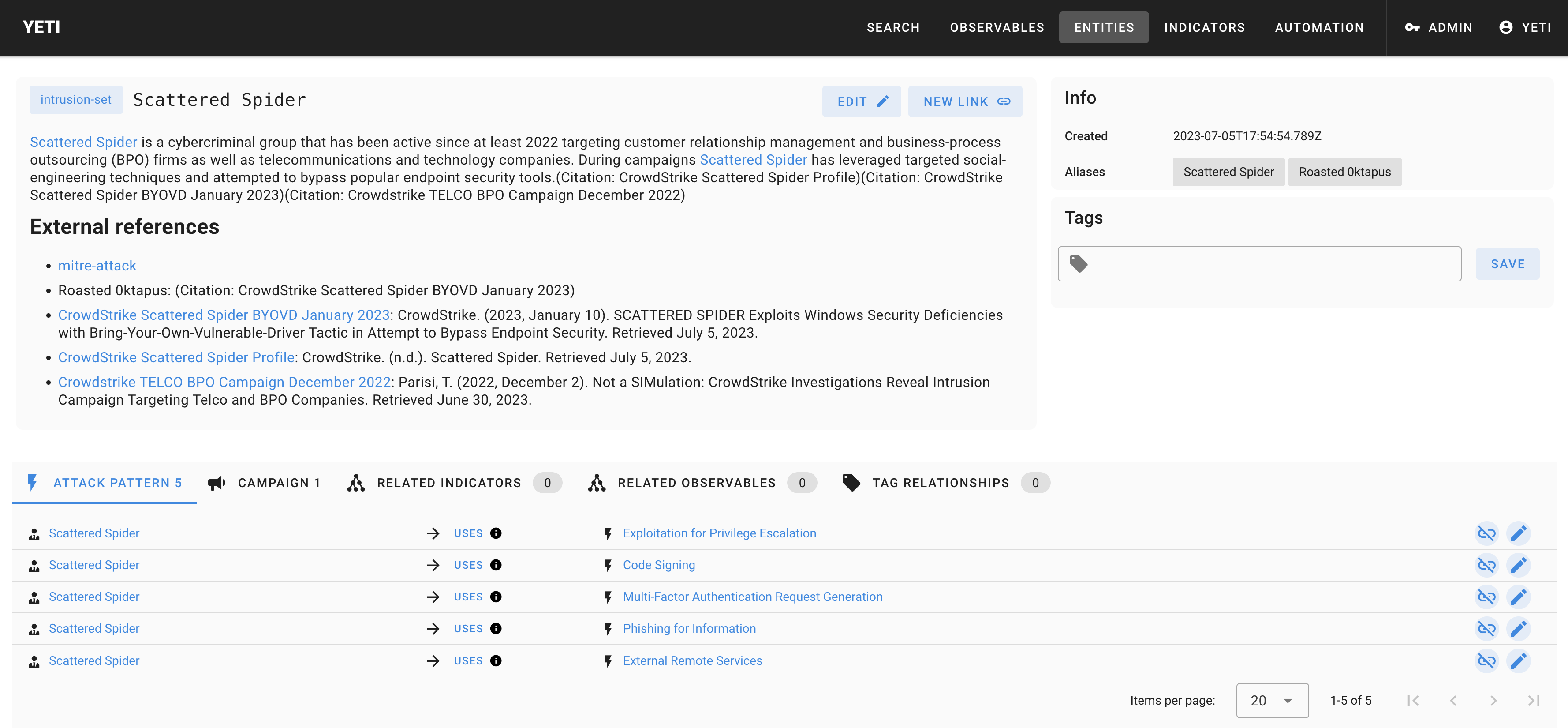
YETI (Your Everyday Threat Intelligence) is an open-source platform to support both cyber threat intelligence (CTI) and digital forensics and incident response (DFIR) teams. It provides a centralized system for managing, searching, and correlating forensic intelligence and threat data.
License: Apache-2.0
Repo: https://github.com/yeti-platform/yeti
GitHub stars: 1K+
Contributors: 50+
Key features include:
- Custom export formats: Allows data export in user-defined formats for ingestion into SIEMs, DFIR platforms, or other external tools.
- Forensic intelligence management: Stores technical artifacts like forensic object definitions, Sigma rules, Yara rules, and reusable queries.
- Bulk observable search: Allows analysts to search large volumes of observables to identify threat patterns and related indicators.
- Threat-focused data linking: Connects threats to their associated TTPs, malware, and forensic artifacts for faster investigation.
- Custom data source integration: Supports the incorporation of internal data sources, analytics, and logic into the platform.
- DFIR backend support: Provides APIs for integration with incident management and malware sandbox systems, enabling automated enrichment and analysis.

Source: Yeti
5 Best Practices for Using Threat Intelligence Software
Organizations should consider the following practices when working with threat intelligence software.
1. Regularly Updating Threat Data Sources
Constantly evolving cyber threats require timely identification and response, which can only be accomplished with current data. Organizations must ensure their threat intelligence platforms are integrated with a variety of data feeds, including proprietary, third-party, and open-source sources, to capture the broadest spectrum of threat information.
Frequent updates provide a comprehensive view of threat landscapes, enabling security teams to make informed decisions about risk management. This practice also ensures the software’s algorithms can adapt to and recognize new threat patterns, improving detection rates.
2. Automating Threat Detection and Response
Automating threat detection and response improves the speed and accuracy of threat management operations. With automated systems, organizations can quickly identify and mitigate threats without significant human intervention. Automation helps reduce response times, ensuring that potential breaches are contained before they cause significant damage. It also frees security personnel from repetitive tasks, allowing them to focus on strategic initiatives.
Automation in threat intelligence software includes features like automated alerts, workflows, and remediation processes. These capabilities enable the system to respond to threats in real-time, systematically reducing the window of opportunity for threat actors. By leveraging automation, organizations ensure continuous protection and improve their security efficiency.
3. Collaborating with Threat Intelligence Communities
Collaboration with threat intelligence communities is a critical best practice for improving security measures. Participating in these communities allows organizations to share insights and access a broader pool of threat intelligence data, enriching their understanding of potential risks. Such collaboration often results in faster threat detection and a more comprehensive approach to cybersecurity.
By engaging with peers and industry experts, organizations can learn about emerging threats and effective countermeasures. This collective intelligence fosters a proactive defense strategy, where insights from various sources help preemptively avert potential attacks. The exchange of information within these communities builds a network of trust and cooperation.
4. Continuous Monitoring and Improvement
Continuous monitoring and improvement are essential for effective threat intelligence management. Organizations must employ real-time monitoring tools to track the evolving threat landscape and adjust their security measures accordingly. This ongoing vigilance allows for early detection of unusual activities and emerging threats, providing security teams a head start in mitigating risks.
Improvement involves regularly assessing the effectiveness of current security protocols and implementing updates and improvements to address new challenges. Feedback loops from monitoring activities inform these improvements, ensuring that security measures remain responsive to changing conditions.
5. Measuring Security Performance and ROI
Measuring security performance and return on investment (ROI) is essential for demonstrating the value of threat intelligence software. Organizations need to track key performance indicators (KPIs) such as response times, threat detection rates, and the number of prevented incidents to gauge the effectiveness of their security measures. This data-driven approach helps in allocating resources efficiently and justifies the investment in threat intelligence solutions.
ROI analysis helps organizations understand the financial benefits of implementing threat intelligence by comparing costs against the potential savings from prevented breaches and reduced downtime. By quantifying the impact of security measures, organizations can make informed decisions about future investments and improvements.
Conclusion
Implementing on-premise threat intelligence software allows organizations to maintain full control over sensitive data while enhancing their ability to detect, analyze, and respond to cyber threats. By leveraging internal infrastructure and integrating threat intelligence into existing security operations, organizations can improve threat visibility and decision-making.
More Cyber Threat Intelligence Explainers
Learn More About Exabeam
Learn about the Exabeam platform and expand your knowledge of information security with our collection of white papers, podcasts, webinars, and more.