SOC vs. CSIRT: 6 Key Differences and Which Organizations Need Both
- 7 minutes to read
Table of Contents
What Is a Security Operations Center (SOC)?
A Security Operations Center (SOC) is a centralized unit that deals with security issues on an organizational level. It monitors, analyzes, and protects against cybersecurity threats, ensuring the security of the organization’s information assets.
The SOC encompasses a team of security analysts and engineers, as well as a suite of security tools that provide real-time monitoring and detection, threat analysis, and incident response capabilities.
The primary goal of a SOC is to identify, investigate, prioritize, and resolve issues that could potentially affect the security posture of an organization. By continuously monitoring network traffic, endpoints, and databases, the SOC can detect anomalies and potential threats, responding swiftly to mitigate risks and protect against security threats.
What Is a Computer Security Incident Response Team (CSIRT)?
A Computer Security Incident Response Team (CSIRT) is a group established to address and manage the aftermath of security breaches, cyber-attacks, or any significant security incidents. The main purpose of a CSIRT is to contain the incident, minimize the damage, and ensure that the organization can recover from the attack as quickly and efficiently as possible. Unlike SOCs, CSIRTs are typically activated in response to an incident rather than monitoring threats around the clock.
CSIRTs play a critical role in the cybersecurity infrastructure by providing expertise in dealing with complex cyber incidents. They coordinate the response efforts, including forensic analysis, to understand the nature and scope of the attack, restore services and systems to normal operation, and develop strategies to improve security postures and prevent future incidents.
This content is part of a series about information security.
Recommended Reading: 4 Types of Cyber Threat Intelligence and Using Them Effectively.
SOC vs. CSIRT: 6 Key Differences
Here are some of the main differences between SOCs and CSIRTs.
1. Primary Functions
A SOC’s core functions include:
- Real-time monitoring and analysis of security events within an organization. By leveraging advanced security information and event management (SIEM) systems, SOCs detect, assess, and respond to cybersecurity threats as they emerge.
- Management of security incidents and events. This includes incident detection, triage, and response, as well as recovery processes post-incident.
- Compliance monitoring and reporting, ensuring that the organization adheres to legal and regulatory requirements regarding cybersecurity.
A CSIRT’s primary functions include:
- Incident response, involving the coordination and management of the organization’s response to a security breach or attack. This includes the initial assessment of the incident, containment of the threat, eradication of the root cause, and recovery of affected systems.
- Guidance and recommendations on preventing future incidents. A CSIRT conducts thorough analyses of security incidents to identify vulnerabilities and weaknesses in the existing security posture. By sharing insights and lessons learned, it contributes to strengthening the organization’s overall cybersecurity defenses.
2. Scope of Responsibilities (Responsibility Assignment Matrix)
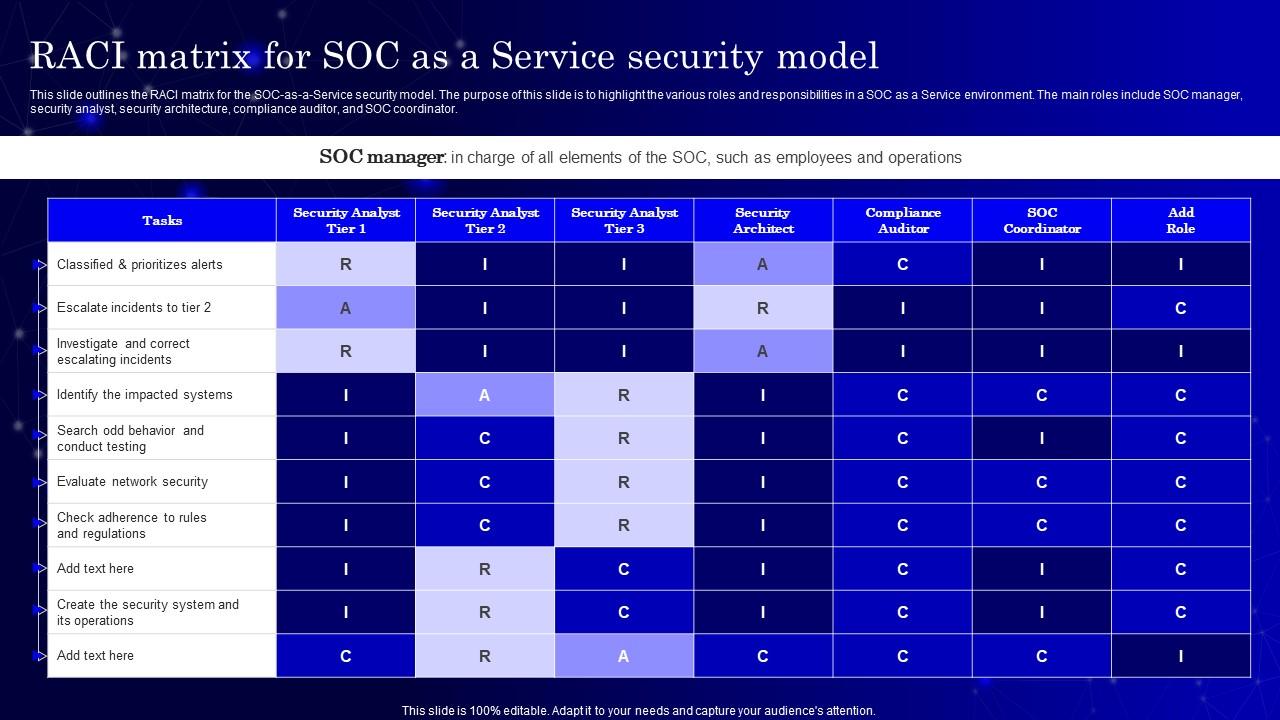
SOCs and CSIRTs also differ in the responsibilities assumed by their staff. The differences can be better understood through a Responsibility Assignment Matrix (also known as a RACI chart). This matrix outlines who is responsible, accountable, consulted, and informed for specific tasks related to cybersecurity within an organization.
Responsibilities in a SOC:
- Responsible: SOC team members are responsible for the continuous monitoring and analysis of the organization’s cybersecurity posture. They actively detect, investigate, and respond to potential security threats.
- Accountable: The SOC manager is accountable for the overall effectiveness of the SOC, ensuring that security measures and protocols are up to date and that the team responds adequately to security incidents.
- Consulted: Subject matter experts within the SOC, or external cybersecurity experts, may be consulted for their expertise on complex security issues or when developing strategic security measures.
- Informed: The broader IT department, senior management, and relevant stakeholders are kept informed about the security status, potential threats, and any significant security incidents that occur.
Example of a SOC RACI chart:

Responsibilities in a CSIRT:
- Responsible: CSIRT members are responsible for responding to, managing, and recovering from security incidents. Their tasks include incident assessment, containment, eradication of threats, and recovery of systems.
- Accountable: The CSIRT leader is accountable for the team’s ability to efficiently and effectively manage cybersecurity incidents, minimizing their impact on the organization.
- Consulted: During an incident response, CSIRTs may consult with SOC teams (if available), forensic experts, legal teams, and other relevant departments for their insights and expertise.
- Informed: Stakeholders, including executive management, affected departments, and, when necessary, external parties such as law enforcement or regulatory bodies, are informed about the incident and recovery progress.
Example of a RACI chart for an incident management process:

3. Organizational Structure and Division into Analyst Tiers
SOCs are typically structured into tiers to efficiently handle security events based on their complexity and severity:
- Tier 1 (Monitoring Analysts): They are the first line of defense, responsible for initial event assessment, filtering false positives, and escalating confirmed threats.
- Tier 2 (Incident Responders): This group handles incidents that escalate beyond Tier 1, performing a deeper analysis and beginning the response process.
- Tier 3 (Subject Matter Experts/Threat Hunters): These are highly specialized analysts who tackle the most complex security issues, engage in threat hunting, and develop strategies for mitigation and prevention.
CSIRTs, while also having a tiered response team, focus less on continuous monitoring and more on incident management:
- Incident Managers: Coordinate the response efforts and serve as the primary contact.
- Forensic Analysts: Specialize in understanding the details of the incident and gathering evidence.
- Recovery Specialists: Focus on restoring systems and services to normal operation.
4. Activity Cadence
SOCs operate on an ongoing basis, conducting continuous surveillance and threat detection to identify and mitigate potential security threats before they can escalate. They aim to maintain a constant state of readiness, with SOC teams diligently monitoring network traffic, analyzing security alerts, and implementing defensive measures around the clock.
CSIRTs are incident-driven, springing into action in the aftermath of a security incident. Their work rhythm is characterized by a cycle of preparedness, response, and recovery. While CSIRTs do engage in planning and preparation activities to enhance their readiness for responding to incidents, their primary focus intensifies when an actual security event occurs.
5. Operational Focus
SOCs focus on continuous surveillance and threat detection across the organization’s networks, systems, and data. They employ technologies to monitor for suspicious activities, prioritize security alerts, and initiate proactive countermeasures against threats. They aim to prevent incidents before they occur, minimizing potential damage to the organization.
CSIRTs concentrate on incident handling and recovery procedures. Their focus shifts toward analyzing the nature and impact of incidents, eradicating threats, and restoring affected systems. CSIRTs prioritize the immediate containment of incidents to reduce damage, followed by recovery actions to ensure business continuity.
5. Technologies and Tools Utilized
SOCs rely heavily on SIEM systems, intrusion detection systems (IDS), and firewall management tools for continuous monitoring and threat detection. They utilize advanced analytical tools to sift through vast amounts of data for potential security threats.
CSIRTs employ a range of tools for forensic analysis, incident documentation, and recovery. This includes forensic software to analyze and gather evidence from compromised systems, as well as ticketing systems to manage and document incident response procedures effectively.
6. Collaboration and Communication
SOCs focus on internal coordination among team members and with other departments to maintain the security posture of the organization. They communicate regularly with stakeholders to report on security statuses and escalations.
CSIRTs emphasize communication with a broader audience, including external stakeholders, law enforcement, and other incident response teams. Their collaboration extends beyond the organization to coordinate efforts in understanding and mitigating cybersecurity incidents, sharing vital information, and implementing best practices.
SOC vs. CSIRT: Should You Have One or Both?
How to Determine if a SOC is Sufficient or CSIRT is Also Needed
Determining whether your organization needs a Security Operations Center (SOC), a Computer Security Incident Response Team (CSIRT), or both depends on several key considerations:
- Nature and scale of digital operations: For organizations with extensive digital assets and operations, a SOC’s continuous monitoring capabilities are essential for early threat detection and prevention. However, if these organizations also face high risks of targeted attacks or data breaches, a dedicated CSIRT becomes necessary.
- Regulatory and compliance requirements: Certain industries are subject to strict regulatory requirements regarding data protection and cybersecurity. Organizations in these sectors may need both a SOC and a CSIRT to not only ensure continuous compliance monitoring but also to demonstrate robust incident response capabilities.
- Risk profile and threat landscape: Evaluate your organization’s risk profile, including the likelihood of facing cybersecurity incidents and the potential impact of these events. High-risk organizations, especially those that are part of critical infrastructure or hold sensitive information, benefit from the specialized incident response and recovery expertise of a CSIRT, alongside a SOC.
- Resource availability: Implementing and maintaining a SOC and a CSIRT requires significant resources, including skilled personnel, technology investments, and ongoing training. Smaller organizations might start with a SOC and rely on external CSIRT services when needed.
- Business continuity and recovery needs: Organizations with critical operational requirements where downtime or data loss would have severe consequences should consider having both a SOC for prevention and detection, and a CSIRT for efficient incident response and recovery to minimize business impact.
When Does the SOC Escalate to the CSIRT?
The decision to escalate from the SOC to the CSIRT typically occurs when a security incident meets certain predefined criteria indicating that it is of a severity or complexity beyond the SOC’s capacity to resolve. This decision is guided by:
- Severity of the threat: If an incident poses a significant threat to critical infrastructure, sensitive data, or could have a substantial financial or reputational impact on the organization, the SOC escalates the issue to the CSIRT. Such incidents may include sophisticated cyber-attacks, data breaches, or ransomware infections that require specialized skills and a coordinated response.
- Complexity and scope: Incidents that extend beyond the initial scope, affecting multiple systems or requiring specialized knowledge or access, necessitate the involvement of the CSIRT. The CSIRT has the expertise to conduct in-depth analyses, forensic investigations, and recovery efforts, which are essential for resolving complex incidents and restoring normal operations.
The transition from SOC to CSIRT involvement is a critical juncture in incident management, ensuring that incidents are addressed with the appropriate level of expertise and resources to minimize their impact on the organization.
SIEM and the future SOC
The security operations center is undergoing an exciting transformation. It is integrating with ops and development departments, and is empowered by powerful new technologies, while retaining its traditional command structure and roles to identify and respond to critical security incidents.
The impact of a next-gen SIEM on the SOC can be significant. It can:
- Reduce alert fatigue via user and entity behavior analytics (UEBA) that goes beyond correlation rules, helps reduce false positives, and discover hidden threats.
- Improve MTTD by helping analysts discover incidents faster and gather all relevant data.
- Improve MTTR by integrating with security systems and leveraging Security Orchestration, Automation and Response (SOAR) technology.
- Enable threat hunting by giving analysts fast and easy access and powerful exploration of unlimited volumes of security data.
Exabeam is an example of a next-generation SIEM which combines data lake technology, visibility into cloud infrastructure, behavioral analytics, an automated incident responder, and a threat hunting module with powerful data querying and visualization.
Explore the Exabeam Security Operations Platform.
More Information Security Explainers
Learn More About Exabeam
Learn about the Exabeam platform and expand your knowledge of information security with our collection of white papers, podcasts, webinars, and more.
-
 Blog
Blog
Exabeam Named a Leader for the Sixth Time in the 2025 Gartner® Magic Quadrant™ for Security Information and Event M...
- Show More